
Proven load carriers
Why PALLETS from Mercer Torgau?
We are one of the largest manufacturers of EPAL pallets in Germany and Europe.
Our daily production capacity is up to 50,000 wooden pallets. Production is carried out in compliance with strict product and quality standards and is PPWR-compliant, as certified by EPAL.

- Startseite
- >
- Product overview
- >
- Pallets
Portfolio
Customised pallets
In addition to the EPAL-licensed Euro pallet, we offer a wide variety of other pallet types. Our product range includes over 80 different pallet types.
Our portfolio includes:
- EPAL Euro pallets (standard)
- Industrial pallets
- EPAL chemical pallets (CP pallets)
- Custom pallets made to customer specifications
We are happy to advise our customers on selecting the right load carrier. In doing so, we take into account criteria such as the weight and dimensions of the goods, as well as whether they will be shipped by sea, land, or air freight.
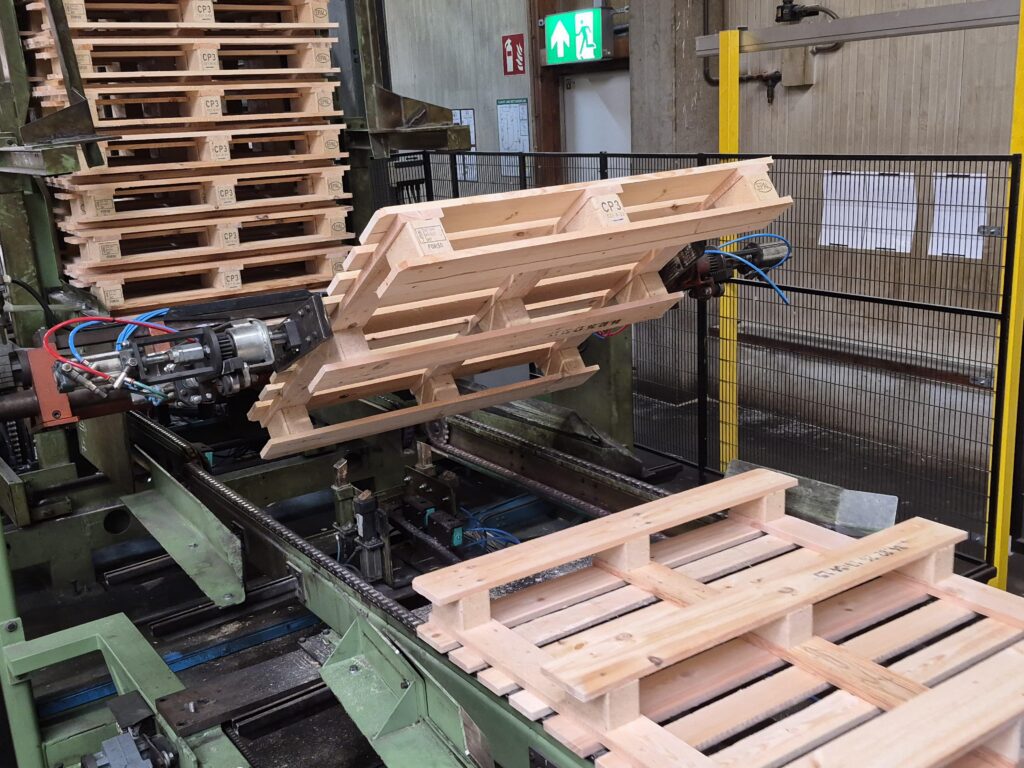
EPAL Chemical Pallets
We offer EPAL-certified chemical pallets (CP pallets) specifically designed for the chemical industry and hazardous materials logistics.
These pallets are engineered to meet the requirements of the chemical industry as well as to handle a variety of products, packaging, and loads.
Our product range includes the CP1, CP2, CP3, and CP5 models, which differ in their dimensions and construction:
- Chemical pallets are suitable for transporting bags, cartons, flexible bulk packaging, fiber drums, canisters, octabins, and big bags.
- The CP3 and CP5 models are also container-compatible (20 ft and 40 ft).
- The chemical pallets are repairable and reusable—providing a durable and reusable solution.
- All CP pallets are IPPC-compliant according to ISPM 15—making them suitable for export to non-EU countries.
Security of supply
Integrated and self-sufficient production
From boards and certified pallet blocks to certified specialty nails, we manufacture all the components needed for our pallets ourselves. We also generate the heat required for drying on-site. The individual components are then assembled into high-quality pallets.
Thanks to our integrated production with a high degree of vertical integration, we are able to handle key production steps in-house. This ensures reliable delivery.
Exportable
ISPM 15-compliant treatment
To this end, after production, they are treated in accordance with ISPM 15 in one of our six continuous-flow dryers or nine drying chambers.
During this process, the wood is heated to a sufficiently high temperature at its core for a sufficiently long period of time (“heat treatment”). The treatment is intended to kill insects and prevent their spread in international trade.
The quality of our Euro pallets is ensured through our partnership with EPAL Deutschland e.V., their certification, and our own quality management system.
Our EPAL pallets meet the applicable requirements of the PPWR (EU Packaging Directive). This is confirmed by EPAL’s Declaration of Conformity. The Declaration of Conformity confirms the pallets’ reusability, recyclability, and material composition. This provides you with the necessary proof of conformity.
We would also be happy to advise you on our other pallet types.
Eco-friendly
Sustainable load carriers
The wood comes from responsibly managed forests in accordance with the Mercer Wood Procurement Policy.
The wood chips produced during cutting are processed into pallet blocks and biofuels.
- The bark from the tree trunks is used to generate energy in our own biomass power plants.
- The heat generated in this process is used, among other things, to dry our pallets.
Euro pallets are designed for repeated use and can be repaired as needed.
Carbon Footprint
A carbon footprint of –39 kg CO₂ per pallet was calculated for our Euro pallets. (The PCF calculation is based on our company-wide emissions accounting for Scope 1, 2, and 3. These metrics comply with the GHG Protocol Corporate and Scope 3 standards, are audited by an independent body, and are published in our annual sustainability report.)
The negative value results from the underlying accounting methodology and takes into account, in particular, the use of wood as a renewable raw material as well as the renewable energy used in production.